Table of Contents
If you are learning Java, one of the most common questions you will hear is:
“Why Java is Object-Oriented?”
This topic is extremely important for Java beginners and is also asked frequently in technical interviews.
In this article, we will explain Object-Oriented Programming (OOP) in Java using simple language, generic real-life examples, and easy diagrams.
What Is Object-Oriented Programming (OOP)?
Object-Oriented Programming (OOP) is a programming approach where software is designed using objects.
An object represents a real-world entity and contains:
- Data → variables
- Behavior → methods
Instead of writing long procedural code, Java encourages developers to model real-world objects in the program.
Why Java Is Object-Oriented?
Java was designed to build large, reliable, and maintainable applications.
Object-Oriented Programming helps Java achieve:
- Better code organization
- Reusability
- Data security
- Scalability
- Easy maintenance
Because of these advantages, Java is widely used for:
- Desktop applications
- Web applications
- Mobile applications
- Backend services
Core OOP Concepts in Java
Java supports four core Object-Oriented Programming concepts:
- Encapsulation
- Inheritance
- Polymorphism
- Abstraction
Let’s understand each concept with simple definitions, examples, and diagram ideas.
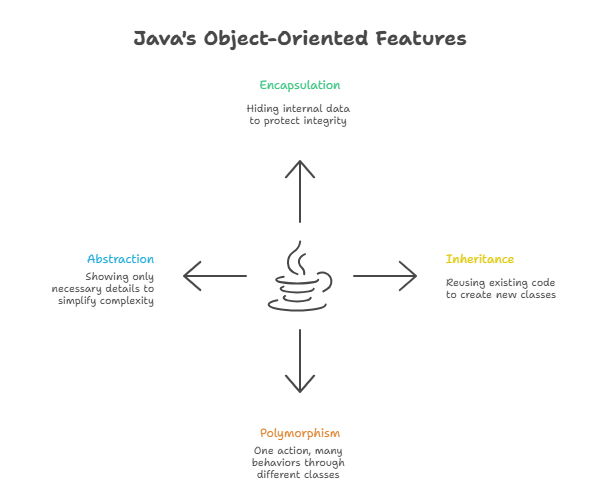
1. Encapsulation – Hiding Internal Data
Definition:
Encapsulation means binding data and methods together and restricting direct access to internal details.
Real-Life Example:
Think of a remote control:
- You press buttons
- You don’t see the internal circuitry
Java Example:
class Person {
    private int age;

    public void setAge(int age) {
        this.age = age;
    }

    public int getAge() {
        return age;
    }
}
Here:
ageis private- Access is controlled using methods
Person Object
 ├── private age
 ├── setAge()
 └── getAge()
Benefits:
- Data protection
- Controlled access
- Cleaner and safer code
2. Inheritance – Reusing Existing Code
Definition:
Inheritance allows one class to reuse properties and methods of another class.
Real-Life Example:
A child inherits traits like height and eye color from parents.
Java Example:
class Animal {
    void eat() {
        System.out.println("Animal eats food");
    }
}

class Dog extends Animal {
}
Here:
Doginherits theeat()method fromAnimal
Animal
   ↑
  Dog
Benefits:
- Code reusability
- Reduced duplication
- Easy maintenance
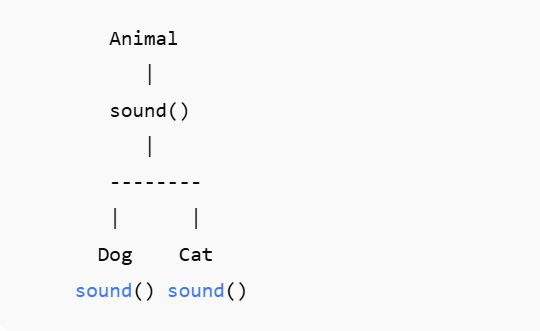
3. Polymorphism – One Action, Many Behaviors
Definition:
Polymorphism means one method can have different behaviors depending on the object.
Real-Life Example:
The same button on a phone:
- Plays music in one app
- Takes photo in another app
Java Example:
class Shape {
    void draw() {
        System.out.println("Drawing shape");
    }
}

class Circle extends Shape {
    void draw() {
        System.out.println("Drawing circle");
    }
}
Shape
└── draw()
↓
Circle → draw circleBenefits:
- Flexible code
- Easy extension
- Better readability
4. Abstraction – Showing Only What Is Needed
Definition:
Abstraction hides unnecessary details and exposes only essential features.
Real-Life Example:
You use a TV remote without knowing how signals work internally.
Java Example:
abstract class Vehicle {
    abstract void start();
}

class Bike extends Vehicle {
    void start() {
        System.out.println("Bike starts with key");
    }
}
Vehicle (Abstract)
↓
BikeBenefits:
- Reduced complexity
- Improved security
- Better understanding
Inheritance + Polymorphism
Is Java 100% Object-Oriented?
No, Java is not 100% object-oriented because it supports primitive data types like:
intcharboolean
However, Java strongly follows OOP principles and is considered a highly object-oriented language.
Common Beginner Mistakes ⚠️
- Confusing encapsulation with abstraction
- Using inheritance unnecessarily
- Ignoring polymorphism benefits
- Writing procedural-style code in Java
Avoiding these mistakes will help you write better Java programs.
Java Interview Questions (Basic)
Q1. Why Java is object-oriented?
Because it supports encapsulation, inheritance, polymorphism, and abstraction.
Q2. Which OOP concept provides data security?
Encapsulation.
Q3. Is Java fully object-oriented?
No, due to primitive data types.
Key Takeaways
- Java follows Object-Oriented Programming
- OOP makes code reusable and maintainable
- Four core concepts form the foundation of Java
- Understanding OOP is essential for Java developers
What’s Next?
➡️ Data Types in Java – Explained Simply
➡️ Class and Object in Java (With Examples)