HashMap in Java – Methods, Examples & Interview Qs

Table of Contents Introduction In our previous articles, we covered ArrayList and how it stores elements in a simple, ordered, resizable list. But what if you need to store data as key-value pairs — like a username mapped to a user ID, or a product name mapped to its price? That’s exactly what HashMap is … Read more
ArrayList in Java

Table of Contents Introduction In the last article, we learned about arrays in Java and saw that arrays have a fixed size once created. But in real applications, we often don’t know in advance how many elements we’ll need to store. This is where ArrayList comes in — a resizable, dynamic alternative to arrays that’s … Read more

Strings in java

Introduction Strings are one of the most commonly used concepts in Java. Whether it’s user input, messages, file names, or data from APIs — almost everything is handled as a string. In Java, strings behave a little differently compared to other data types. They are objects, they are immutable, and Java provides a rich set … Read more

Methods in Java: A Simple Guide with Syntax and Examples

Introduction When you start writing Java programs, you’ll quickly notice one problem — repetition. The same logic appears again and again. This is where methods come in. A method in Java allows you to write code once and use it multiple times. Methods help keep programs organized, readable, and easy to change later. Almost every … Read more

Control Statements in Java: Decision Making and Loops Explained

Introduction Control statements in Java are used to control the flow of execution of a program. By default, Java programs execute statements one after another in a sequential manner. However, real-world programs need to make decisions, repeat tasks, and execute different blocks of code based on conditions. This is where control statements become essential. Control … Read more

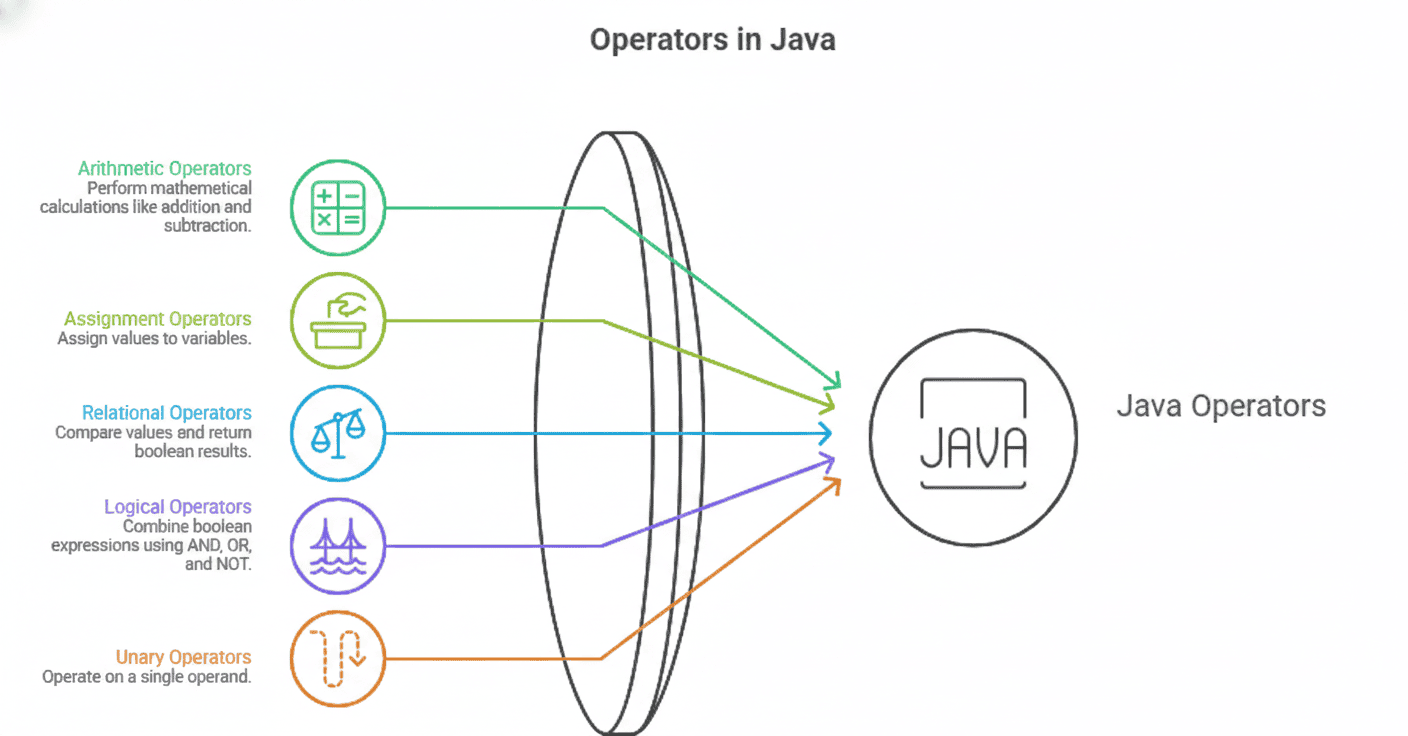
Operators in Java: Types, Examples, and Truth Tables

operators in java

Introduction Operators in Java are special symbols used to perform operations on variables and values. They allow Java programs to do calculations, compare values, make decisions, and combine conditions. Without operators, writing meaningful Java programs would not be possible. Whether you are performing arithmetic calculations, checking conditions in an if statement, or assigning values to … Read more

Variables in Java: Types, Scope, and Examples

Introduction Variables in Java are used to store data that can be used and changed during program execution. Every Java program relies on variables to hold information such as numbers, text, or logical values. A variable acts as a container that stores data in memory, allowing developers to perform operations and manipulate values easily. Java … Read more

Why Java Is Object-Oriented? OOP Concepts Explained Simply (With Examples & Diagrams)

If you are learning Java, one of the most common questions you will hear is:“Why Java is Object-Oriented?” This topic is extremely important for Java beginners and is also asked frequently in technical interviews.In this article, we will explain Object-Oriented Programming (OOP) in Java using simple language, generic real-life examples, and easy diagrams. What Is … Read more