
Table of Contents
Introduction:
Data types in Java define the type of data that a variable can hold and how much memory is required to store that data. Java is a strongly typed language, which means every variable must be declared with a specific data type before it is used. This strict typing helps the compiler catch errors early and ensures better performance, reliability, and security.
Understanding data types is one of the most important fundamentals of Java programming. Whether you are a beginner learning Java for the first time or someone revising core concepts, data types form the base for variables, operators, control statements, and object-oriented programming.
In this article, you will learn what data types are in Java, their types, how primitive and non-primitive data types differ, and why they are important, with simple and generic examples.
What Is a Data Type in Java?
A data type specifies:
- The kind of value a variable can store
- The amount of memory allocated
- The operations that can be performed on the variable
For example:
int number = 10;Here, int is the data type, number is the variable name, and 10 is the value. The data type tells Java that this variable will store an integer value.
Types of Data Types in Java
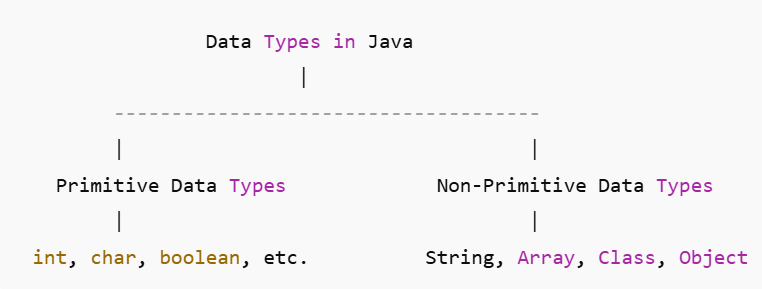
Java data types are broadly classified into two main categories:
- Primitive Data Types
- Non-Primitive (Reference) Data Types
Java Data Types Classification Diagram

Primitive Data Types in Java
Primitive data types are the most basic data types in Java. They store simple values directly in memory and do not have methods. Java provides eight primitive data types.
List of Primitive Data Types
- byte – stores small whole numbers
- short – stores slightly larger whole numbers
- int – stores integers (most commonly used)
- long – stores very large whole numbers
- float – stores decimal values with single precision
- double – stores decimal values with double precision
- char – stores a single character
- boolean – stores true or false
Example:
int age = 25;
double salary = 45000.75;
char grade = 'A';
boolean isActive = true;
Key Characteristics of Primitive Data Types
- Store single values
- Faster compared to objects
- Consume less memory
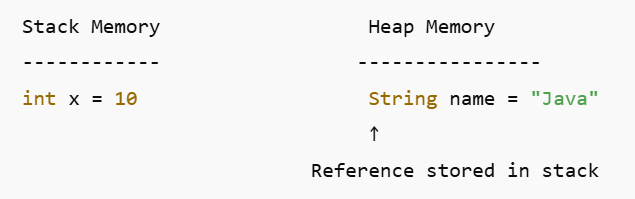
- Stored in stack memory
- Do not have methods
Primitive data types are widely used for calculations and performance-critical code.
Non-Primitive Data Types in Java
Non-primitive data types are also known as reference data types. Instead of storing actual values, they store references (memory addresses) of objects. These data types are more powerful and flexible than primitive types.
Common Non-Primitive Data Types
- String
- Array
- Class
- Object
- Interface
Example:
String language = "Java";Here, the variable language holds a reference to a String object stored in heap memory.
Key Characteristics of Non-Primitive Data Types
- Can store multiple values
- Have methods and properties
- Stored in heap memory
- Can be created using the
newkeyword - More flexible than primitive types
Primitive vs Non-Primitive Memory Representation

String: Primitive or Non-Primitive?
Although String looks simple, it is not a primitive data type. In Java, String is a class, which makes it a non-primitive data type.
String message = "Hello";Strings have methods like length(), toUpperCase(), and substring(), which proves they are objects.
Why Data Types Are Important in Java?
Data types play a crucial role in Java programming because they:
- Improve program performance
- Ensure type safety
- Reduce runtime errors
- Help in efficient memory usage
- Make code easier to understand and maintain
Choosing the correct data type is essential for writing optimized and clean Java programs.
Common Beginner Mistakes ⚠️
Some common mistakes beginners make include:
- Using
intinstead oflongfor large values - Forgetting to add
fwhile declaring float values - Confusing
charwithString - Using the wrong data type for calculations
Avoiding these mistakes improves code quality and prevents bugs.
Interview Tip
👉 Java is not 100% object-oriented because it supports primitive data types.
This is a very frequently asked interview question.
Conclusion
Data types in Java are the foundation of the language. Primitive data types help store simple values efficiently, while non-primitive data types allow developers to work with complex data structures and objects. Understanding the difference between them is essential for writing correct, efficient, and scalable Java programs. Mastering data types makes learning advanced Java concepts much easier.